
Dynamic Metrology Services
Why A2LA Accreditation?
What does that mean?
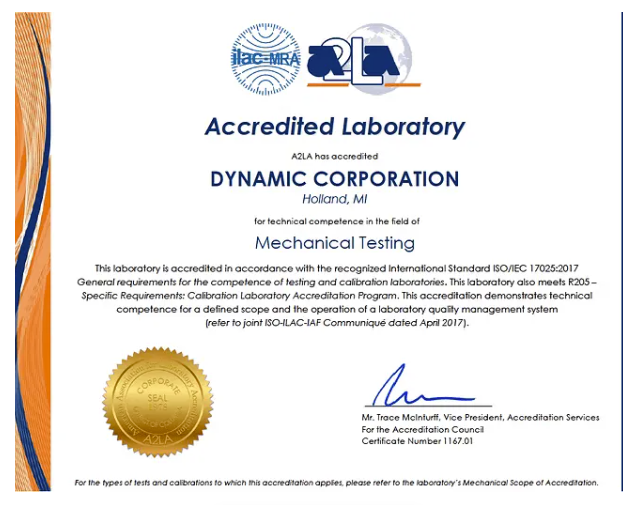
Laboratory accreditation use criteria and procedures specifically developed to determine technical competence. Qualified technical assessors perform in-depth evaluations of all factors that impact the accuracy, reliability, and integrity of testing or calibration data. This process is based on the internationally recognized ISO/IEC 17025 standard, which is used worldwide to assess laboratories, along with additional technical requirements developed in coordination with regulators and industry organizations.
Accreditation bodies apply ISO/IEC 17025 to determine a laboratory’s ability to consistently produce accurate and dependable test and calibration results. The assessment includes, but is not limited to, the following areas:
- Technical competence of laboratory personnel
- Appropriateness and validity of test and calibration methods
- Traceability of measurements and calibrations to national or international standards
- Suitability, calibration, and maintenance of test equipment
- Control and monitoring of the testing environment
- Proper sampling, handling, and transportation of test items
- Quality assurance and integrity of testing and calibration data
Accreditation to ISO/IEC 17025 incorporates the same quality management principles found in ISO 9001. To maintain accreditation, laboratories are subject to regular reassessments to ensure ongoing compliance and sustained technical competence. When applicable, laboratories must also participate in proficiency testing programs as a continuous demonstration of their performance and capability. Dynamic Metrology adheres to all these practices and standards.
How does this benefit you as the customer?
Minimizes risk – Accreditation ensures you are selecting a laboratory with proven technical competence and a robust quality management system.
Avoids costly retesting – Customer confidence is strengthened by knowing products have been evaluated by an independent, technically competent testing or calibration laboratory that has been assessed by an impartial third party.
Reduces costs and improves international acceptance – Through international agreements such as the International Laboratory Accreditation Cooperation (ILAC) Mutual Recognition Arrangement, accredited laboratories receive global recognition. This allows test and calibration data to be more readily accepted in international markets, helping to reduce or eliminate the need for retesting in the importing country.
Simplifies the selection of reliable laboratory services – Laboratory accreditation formally recognizes competent laboratories, making it easier for customers to identify trusted testing and calibration providers that meet their specific requirements.
Builds confidence in measurement results – A2LA accreditation provides assurance that measurement results are accurate, reliable, and technically sound.
Let's start the conversation
Phone: (616) 450-3744
Email:dcmetrology@dynamicmetrology.com
